News and Events
New book on the de Clare family, reviewed by Anne Davies
Three Chevrons Red. The Clares: A Marcher Dynasty in Wales, England and Ireland
By Paul R. Davis. Logaston Press, Little Logaston, Herefordshire HR3 6Q (2013). ISBN 978 1 906663 80 3. Paperback £15.00, 359 pages.
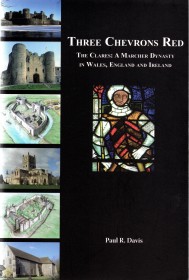 This book is about one of the most important families in medieval England. Their English history started with the Norman Conquest and they are intimately involved with the major events of the following centuries until the last male heir is killed at Bannockburn in 1314. In his book Davis covers the family’s origins in Normandy as distant relatives and close associates of the future William I of England, and their subsequent rise to great heights in the Anglo-Norman aristocracy by means of prowess in battle, sheer acquisitiveness, marriage, and it would seem, a cautious approach to taking sides during times of civil unrest, such as the 15-year long struggle for the throne between Matilda and Stephen in the middle of the 12th century, and the barons revolt (1258-65) led by Simon de Montfort.
The English were largely subdued within 20 years of the conquest, but subjugation of the Welsh took another two centuries. William I created a buffer zone between Wales in England termed the March and allowed the lords of the March almost unlimited power within their own territories. In 1110 Gilbert fitz Richard[1]was granted land in the Marches by Henry I, and the family was on its way to becoming the most powerful Marcher dynasty. Gilbert’s great-great grandson Richard, earl of Gloucester and Hertford, and lord Marcher of Glamorgan (1222-62), held extensive lands in Wales, England and Ireland, and was the wealthiest magnate in England outside of the immediate royal family.
Holding on to estates, particularly in rebellious Wales and Ireland, involved the building and refurbishment of numerous castles, and in his foreword, Davis acknowledges that it was his interest in the de Clares as the builders of some monumental Welsh castles that led to the writing of this book. Indeed this well-laid out and attractive paperback is lavishly illustrated with photographs and drawings, mainly of castles, but also of other buildings and subjects relevant to the text. That there is an emphasis on castles and their construction is hardly surprising, but this is still an unusually readable history book, giving an interesting account of the more prominent de Clare family members, set in the context of the affairs of state in post-conquest England.
I am not a historian and therefore not qualified to judge the text academically, but I was pleased to see both a bibliography and a list of references and notes. I have three minor quibbles. The first (page 24) is that, contrary to what Davis says, there is one small piece of circumstantial evidence to suggest that Richard de Bienfaite may have taken part in the Battle of Hastings[2]. The second concerns the drawing on page 30, which shows how Clare Castle may have looked at the time of Domesday, and includes priory buildings in the outer bailey. An Anglo-Saxon church (also known as a college of secular canons) had been established at Clare earlier in the 11th century, and this was subsumed within the Norman castle, but as far as I know, no details of the structure or exact position exist[3]. Finally, readers might have appreciated a little help in understanding the approximate present day value of the sums of money in the text, variously expressed as either marks or pounds sterling (e.g. pages 123, 133, 139 and 224). As I said, these are minor reservations and I would wholeheartedly recommend this book to anyone interested in medieval history, medieval castles or, as in my case, a history of the family who built a castle at the bottom of my garden.
Anne Davies, January 2014
Three Chevrons Red is available at Harris & Harris Books, 7b High St, Clare CO10 8NY. Books published by Clare Ancient House Museum can be ordered through Harris & Harris during the period when the Museum is closed for the winter.
[1] Son of the first Anglo-Norman de Clare, Richard de Bienfaite, who died c.1090.
[2] Douglas, D.C. Companions of the Conqueror, History, xxviii, 1943, pages 129-147.
[3] Conversion of the church to a Benedictine priory did not start until 1090 and anyway it may have been situated the inner bailey, as recent excavation there (May and September 2013) have revealed a number of graves.
What is inside...

The medieval pilgrim with his signature cloak, walking stick and hat (showing 3 badges attached), and a large replica of the badge for St Edmund. Part of the exhibition on Elizabeth de Burgh, who made several pilgrimages in her lifetime. She, however, would have travelled by coach or carriage.
